Pelatihan Deteksi Dini Stunting pada Kader
Abstract
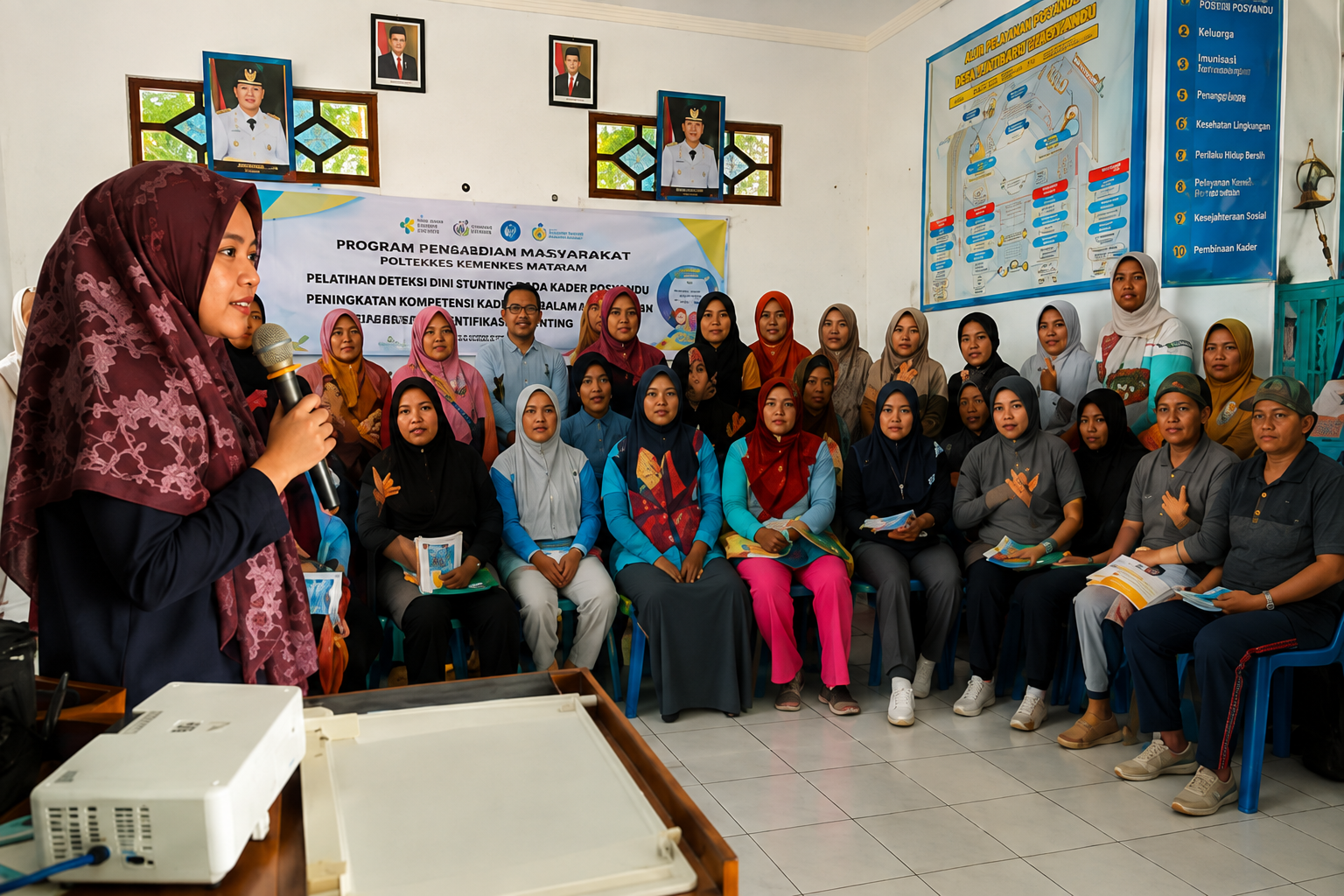
Stunting remains a critical public health challenge in Indonesia, necessitating strengthening community-level detection capacity. This study aimed to improve the knowledge and skills of Posyandu (Integrated Service Post) cadres in early stunting detection. The community service program involved 30 Posyandu cadres in Jatibaru Village, Asakota District, Bima City. The intervention used a multi-method approach consisting of interactive lectures, educational booklets, animated video presentations, simulation exercises, and hands-on anthropometric practice. Evaluation used pre- and post-test questionnaires to assess knowledge gains and an observation checklist based on WHO standards to evaluate anthropometric competency. Data were analyzed using a paired t-test. Results showed a significant increase in the mean knowledge score from 58.3 to 87.5 (p < 0.001), with cadres achieving good knowledge increasing from 13.3% to 90.0%. Anthropometric competency levels reached 96.7% for digital scale use, 93.3% for mid-upper arm circumference measurement, 86.7% for length measurement using a measuring board, and 83.3% for growth chart interpretation. This training program effectively improved the cadres' cognitive and psychomotor competencies, supporting community-based stunting prevention and early detection efforts.
Downloads
References
Amriviana, M. P., Khairunnisa, C., & Sasongko, T. H. (2023). Parental stature as a risk factor for stunting in Indonesia: A systematic review and meta-analysis. Narra J, 3(2), 1–14. https://doi.org/10.52225/narra.v3i2.144
Arqam, Mhd. L., Firdaus, A. A., Atmojo, A. M., Saputri, G. Z., Furizal, Palahuddin, & Sirnopati, R. (2026). Integrating education-based interventions and machine learning for stunting prevention: A case study in East Lombok, Indonesia. Dialogues in Health, 8(6), 1–20. https://doi.org/10.1016/j.dialog.2025.100264
Awaludin, A. A., Nurrachmawati, A., Fitriani, A. D., & Casia Reski. (2025). The Long-Term Impact of Childhood Stunting on Cognitive Development and Educational Outcomes. Jurnal Penelitian Pendidikan IPA, 11(8), 70–77. https://doi.org/10.29303/jppipa.v11i8.12198
Bahar, H., Effendy, D. S., & Lestari, H. (2025). Strengthening the Role of Community Health Workers in High Stunting Prevalence Areas of Kendari City, Southeast Sulawesi Province, Indonesia: A Qualitative Study. Public Health of Indonesia, 11(4), 1–9. https://doi.org/10.36685/phi.v11i4.983
Chen, C., Hardjo, S., Sonnert, G., Hui, J., & Sadler, P. M. (2023). The role of media in influencing students’ STEM career interest. International Journal of STEM Education, 10(1), 1–19. https://doi.org/10.1186/s40594-023-00448-1
Deshpande, A., & Ramachandran, R. (2022). Early childhood stunting and later life outcomes: A longitudinal analysis. Economics & Human Biology, 44(1), 1–12. https://doi.org/10.1016/j.ehb.2021.101099
Ekayanthi, N. W. D., Susilawati, E. H., & Pramanik, N. D. (2022). The Impact of Posyandu Cadre Training on the IYCF-Related Knowledge, Attitudes, and Communication Skills. Open Access Macedonian Journal of Medical Sciences, 10(E), 1683–1689. https://doi.org/10.3889/oamjms.2022.10043
Goudet, S. M., Bogin, B. A., Madise, N. J., & Griffiths, P. L. (2019). Nutritional interventions for preventing stunting in children (birth to 59 months) living in urban slums in low- and middle-income countries (LMIC). Cochrane Database of Systematic Reviews, 2019(10), 1–12. https://doi.org/10.1002/14651858.CD011695.pub2
Habimana, J. de D., Habumugisha, T., Matsiko, E., Karemera, J., Korukire, N., Umugwaneza, M., Rugema, L., & Munyanshongore, C. (2026). Community-driven strategies for preventing childhood stunting: perspectives from parents and front-line workers in Rwanda. Frontiers in Nutrition, 13(2), 1–12. https://doi.org/10.3389/fnut.2026.1725510
Husnida, N., Rahmatina, A., Wiwaha, G., Adnani, Q. E. S., & Hilmanto, D. (2026). Health Cadre Mentoring Model in Stunting Prevention Programs: A Systematic Literature Review. Journal of Multidisciplinary Healthcare, Volume 19(5), 1–18. https://doi.org/10.2147/JMDH.S594400
Irdawati, I., Arifah, S., Muhlisin, A., Kusumawati, Y., Siti Zulaekah, A., Nugrahwati, E., Putri, N. F., & Syaiful, A. A. (2024). Efforts of Increase Cadre Capacity about Stunting Prevention. MethodsX, 13(12), 1–6. https://doi.org/10.1016/j.mex.2024.102720
Jiang, Y. (2026). A Gamified Incentive Model for Knowledge Internalization in Higher Education. International Journal of Knowledge Management, 22(1), 1–16. https://doi.org/10.4018/IJKM.401492
Liu, P.-Y., Lin, Y.-T., Chiou, Y.-H., & Lee, M.-S. (2025). A four-year, mixed-family and community-based growth monitoring and promotion program using multi-level modeling to address undernutrition in children in Cambodia. Frontiers in Public Health, 13(6), 1–12. https://doi.org/10.3389/fpubh.2025.1572941
Meher, C., Zaluchu, F., & Eyanoer, P. C. (2023). Local approaches and ineffectivity in reducing stunting in children: A case study of policy in Indonesia. F1000Research, 12(2), 1–14. https://doi.org/10.12688/f1000research.130902.1
Moloro, A. H., Sabo, K. G., Mare, K. U., Wengoro, B. F., Endrias, E. E., Ibrahim, R. M., Dubie, T., Ebrahim, O. A., & Lahole, B. K. (2026). Prevalence of stunting and its determinants among children under five in 35 Sub-Saharan African countries (2011–2024): Insights from recent demographic health survey data using a generalized linear mixed-effects model with robust poisson regression. PLOS One, 21(3), 1–29. https://doi.org/10.1371/journal.pone.0344358
Nicolaou, C., Matsiola, M., & Kalliris, G. (2022). The Challenge of an Interactive Audiovisual-Supported Lesson Plan: Information and Communications Technologies (ICTs) in Adult Education. Education Sciences, 12(11), 1–47. https://doi.org/10.3390/educsci12110836
Oliveira, M. H. de, Pereira, D. dos S., Melo, D. S., Silva, J. C., & Conde, W. L. (2022). Accuracy of international growth charts to assess nutritional status in children and adolescents: a systematic review. Revista Paulista de Pediatria, 40(1), 1–12. https://doi.org/10.1590/1984-0462/2022/40/2021016
O’Reilly, C., Devitt, A., & Hayes, N. (2022). Critical thinking in the preschool classroom - A systematic literature review. Thinking Skills and Creativity, 46(12), 1–20. https://doi.org/10.1016/j.tsc.2022.101110
Sachdev, H. S., & Borghi, E. (2024). Should a single growth standard be used to judge the nutritional status of children under age 5 years globally? No. The American Journal of Clinical Nutrition, 120(4), 759–763. https://doi.org/10.1016/j.ajcnut.2024.04.014
Siswati, T., Iskandar, S., Pramestuti, N., Raharjo, J., Rialihanto, M. P., Rubaya, A. K., & Wiratama, B. S. (2022). Effect of a Short Course on Improving the Cadres’ Knowledge in the Context of Reducing Stunting through Home Visits in Yogyakarta, Indonesia. International Journal of Environmental Research and Public Health, 19(16), 1–10. https://doi.org/10.3390/ijerph19169843
Sitorus, R. S., Gurusinga, R., Sitorus, S., Sinambela, M., & Sirait, R. A. (2026). Smart Digital Education model of cadres empowerment for early stunting prevention. Journal of Public Health Research, 15(1), 1–21. https://doi.org/10.1177/22799036261423665
Sukmawati, S., Hermayanti, Y., Fadlyana, E., Maulana, I., & Mediani, H. S. (2025a). Health cadres’ experiences in detecting and preventing childhood stunting in Indonesia: a qualitative study. BMC Public Health, 25(1), 1–10. https://doi.org/10.1186/s12889-025-24192-z
Sukmawati, S., Hermayanti, Y., Fadlyana, E., Maulana, I., & Mediani, H. S. (2025b). Health cadres’ experiences in detecting and preventing childhood stunting in Indonesia: a qualitative study. BMC Public Health, 25(1), 1–10. https://doi.org/10.1186/s12889-025-24192-z
Tampake, R., Arianty, R., Mangundap, S. A. ., Emy, B., & Sasmita, H. (2021a). The Effectiveness of Training on Improving the Ability of Health Cadres in Early Detection of Stunting in Toddlers. Open Access Macedonian Journal of Medical Sciences, 9(E), 373–377. https://doi.org/10.3889/oamjms.2021.6067
Tampake, R., Arianty, R., Mangundap, S. A. ., Emy, B., & Sasmita, H. (2021b). The Effectiveness of Training on Improving the Ability of Health Cadres in Early Detection of Stunting in Toddlers. Open Access Macedonian Journal of Medical Sciences, 9(E), 373–377. https://doi.org/10.3889/oamjms.2021.6067
Tokuhama-Espinosa, T., Simmers, K., Batchelor, D., Nelson, A. D., & Borja, C. (2023). A Theory of Mental Frameworks. Frontiers in Psychology, 14(7), 1–12. https://doi.org/10.3389/fpsyg.2023.1220664
Vaivada, T., Akseer, N., Akseer, S., Somaskandan, A., Stefopulos, M., & Bhutta, Z. A. (2020). Stunting in childhood: an overview of global burden, trends, determinants, and drivers of decline. The American Journal of Clinical Nutrition, 112(9), 777S-791S. https://doi.org/10.1093/ajcn/nqaa159
Wahyuningsih, W., Bukhari, A., Juliaty, A., Erika, K. A., Pamungkas, R. A., Siokal, B., Saharuddin, S., & Amir, S. (2022). Stunting Prevention and Control Program to Reduce the Prevalence of Stunting: Systematic Review Study. Open Access Macedonian Journal of Medical Sciences, 10(F), 190–200. https://doi.org/10.3889/oamjms.2022.8562
Wanda, D., Astuti, A., Adawiyah, R., Syaiful, A. A., Azizah, L. F. N., Azkiyati, A. M., & Huda, M. H. (2025). Exploring practical issues in children’s anthropometric measurements: A qualitative descriptive study involving Indonesian health professionals and community health workers. Belitung Nursing Journal, 11(5), 538–546. https://doi.org/10.33546/bnj.3987
Widiasih, R., Sunjaya, D. K., Rahayuwati, L., Rusyidi, B., Ermiati, Sari, C. W. M., Mardani, Rusdi, & Tung, S. E. H. (2025a). Evaluating the knowledge, roles, and skills of health cadres in stunting prevention: A mixed-method study in Indonesia. Belitung Nursing Journal, 11(3), 330–339. https://doi.org/10.33546/bnj.3722
Widiasih, R., Sunjaya, D. K., Rahayuwati, L., Rusyidi, B., Ermiati, Sari, C. W. M., Mardani, Rusdi, & Tung, S. E. H. (2025b). Evaluating the knowledge, roles, and skills of health cadres in stunting prevention: A mixed-method study in Indonesia. Belitung Nursing Journal, 11(3), 330–339. https://doi.org/10.33546/bnj.3722
Xia, L., Wang, L., & Huang, C. (2024). Implementing a Social Presence-Based Teaching Strategy in Online Lecture Learning. European Journal of Investigation in Health, Psychology and Education, 14(9), 2580–2597. https://doi.org/10.3390/ejihpe14090170
Dengan mengirimkan artikel ke Jurnal Pengabdian Masyarakat Cendikia Jenius, penulis setuju dengan kebijakan ini. Tidak diperlukan persetujuan dokumen khusus.
Hak Cipta :

Lisensi Creative Commons Atribution-ShareAlike 4.0 Internasional
Hak cipta atas artikel apa pun di Jurnal Pengabdian Masyarakat Cendikia Jenius dipegang penuh oleh penulisnya di bawah Lisensi Creative Commons Atribution-ShareAlike 4.0 Internasional (CC BY-SA 4.0)
- Hak cipta pada setiap artikel adalah milik penulis.
- Penulis mempertahankan semua hak mereka atas karya yang diterbitkan, tak terbatas pada hak-hak yang diatur dalam laman ini.
- Penulis mengakui bahwa Jurnal Pengabdian Masyarakat Cendikia Jenius sebagai yang pertama kali mempublikasikan dengan Lisensi Creative Commons Atribution-ShareAlike 4.0 Internasional (CC BY-SA 4.0).
- Penulis dapat memasukan tulisan secara terpisah, mengatur distribusi non-ekskulif dari naskah yang telah terbit di jurnal ini kedalam versi yang lain (misal: dikirim ke respository institusi penulis, publikasi kedalam buku, dll), dengan mengakui bahwa naskah telah terbit pertama kali pada Jurnal Pengabdian Masyarakat Cendikia Jenius.
- Penulis menjamin bahwa artikel asli, ditulis oleh penulis yang disebutkan, belum pernah dipublikasikan sebelumnya, tidak mengandung pernyataan yang melanggar hukum, tidak melanggar hak orang lain, tunduk pada hak cipta yang secara eksklusif dipegang oleh penulis.
- Jika artikel dipersiapkan bersama oleh lebih dari satu penulis, setiap penulis yang mengirimkan naskah menjamin bahwa dia telah diberi wewenang oleh semua penulis bersama untuk menyetujui hak cipta dan pemberitahuan lisensi (perjanjian) atas nama mereka, dan setuju untuk memberi tahu rekan penulis persyaratan kebijakan ini. Jurnal Pengbadian Masyarakat Cendikia Jenius tidak akan dimintai pertanggungjawaban atas apa pun yang mungkin timbul karena perselisihan internal penulis.
Lisensi :
Jurnal Pengabdian Masyarakat Cendikia Jenius diterbitkan berdasarkan ketentuan Lisensi Creative Commons Atribution-ShareAlike 4.0 Internasional (CC BY-SA 4.0) Lisensi ini mengizinkan setiap orang untuk :
Menyalin dan menyebarluaskan kembali materi ini dalam bentuk atau format apapun serta menggubah, memperbaiki, dan membuat ciptaan turunan, bahkan untuk kepentingan komersial, selama mereka mencantumkan kredit kepada Penulis atas ciptaan asli.