Efektivitas Modul Evakuasi Mandiri dalam Meningkatkan Kesiapsiagaan Keluarga Menghadapi Bencana Banjir
Abstract
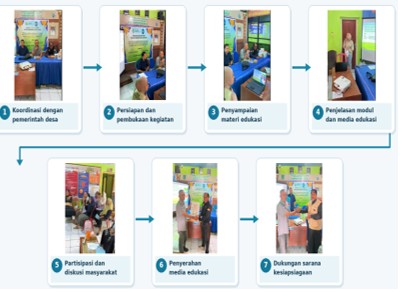
This community service program aimed to improve family knowledge and preparedness for flood disasters through module-based education on independent evacuation. The program was conducted in Belo Village, Bima Regency, involving 30 family representatives. The implementation methods included initial assessment, education using a validated module, demonstrations, evacuation simulations, group discussions, and post-intervention evaluation. The materials covered flood risk identification, independent evacuation procedures, emergency kit preparation, evacuation route identification, and family communication planning. The results showed an improvement in participants’ knowledge, with the proportion demonstrating good knowledge increasing from 13.3% before the intervention to 90.0% afterward. The mean knowledge score increased from 1.63 to 2.90, with a statistically significant difference (p<0.001). Family preparedness also improved across all evaluated domains. In conclusion, module-based education combined with participatory practical activities may improve family knowledge and preparedness and support community-based disaster risk reduction in flood-prone areas.
Downloads
References
Abunyewah, M., Erdiaw-Kwasie, M. O., Okyere, S. A., Thayaparan, G., Byrne, M., Lassa, J., Zander, K. K., Fatemi, M. N., & Maund, K. (2023). Influence of personal and collective social capital on flood preparedness and community resilience: Evidence from Old Fadama, Ghana. International Journal of Disaster Risk Reduction, 94, Article 103790. https://doi.org/10.1016/j.ijdrr.2023.103790
Amberson, T., Heagele, T., Wyte-Lake, T., Couig, M. P., Bell, S. A., Mammen, M. J., Wells, V., & Castner, J. (2023). Social support, educational, and behavioral modification interventions for improving household disaster preparedness in the general community-dwelling population: A systematic review and meta-analysis. Frontiers in Public Health, 11, Article 1257714. https://doi.org/10.3389/fpubh.2023.1257714
Aslanoğlu, A., Bilgiç, N., Murad, A. A., Elshatarat, R. A., Abujaber, D. A., Al Qasim, E., Siddiq, N. A., Sobeh, D. E., Eltayeb, M. M., & Saleh, Z. T. (2024). The impact of educational and training programs on disaster awareness and preparedness among health sciences students: A quasi-experimental study. International Journal of Disaster Risk Reduction, 113, Article 104888. https://doi.org/10.1016/j.ijdrr.2024.104888
Bachri, S., Hakiki, A. R. R., Wibowo, N. A., Sumarmi, Amini, R., Yosritzal, & Nursaribilah, E. (2024). Developing an education support system for disaster management through an ethnoscience-based digital disaster learning module. International Journal of Disaster Risk Reduction, 100, Article 104214. https://doi.org/10.1016/j.ijdrr.2023.104214
Ebhuoma, E. E., Nene, N. J., & Leonard, L. (2024). Analysis of urban households’ preparedness and municipal interventions to build flood resilience in Durban, South Africa: Implications for SDG 11. Environmental and Sustainability Indicators, 23, Article 100454. https://doi.org/10.1016/j.indic.2024.100454
Fazeli, S., Rashidi, T. H., Mojtahedi, M., & Haghani, M. (2025). Measuring individual preparedness for flood and bushfire emergencies. International Journal of Disaster Risk Reduction, 127, Article 105651. https://doi.org/10.1016/j.ijdrr.2025.105651
Flores, F. P., Prasetyo, Y. T., Grahani, B. P., Lukodono, R. P., Benito, O. P., Redi, A. A. N. P., Cahigas, M. M. L., Nadlifatin, R., & Gumasing, M. J. J. (2024). Determining factors influencing flood preparedness among citizens in Jakarta: A protection motivation theory approach. Environmental Development, 51, Article 101042. https://doi.org/10.1016/j.envdev.2024.101042
Forsyth, J., Roberts, T., & Brewer, G. (2023). Conceptualising risk communication barriers to household flood preparedness. Urban Governance, 3(2), 116–129. https://doi.org/10.1016/j.ugj.2023.02.001
Garibay Rubio, C. R., Yamori, K., Nakano, G., Marín Cambranis, R. H., Ortiz Torres, J. A., Ávila Zepeda, A. P., Sagahon Aguilar, S., Franco Rodríguez, R. M., & Peralta Gutiérrez, A. R. (2024). Theoretical and practical considerations in the creation of a disaster risk reduction educational strategy at the primary education level: A case study of Mexico City. International Journal of Disaster Risk Reduction, 105, Article 104320. https://doi.org/10.1016/j.ijdrr.2024.104320
Genç, F. Z., Yıldız, S., Erdal, A., & Bilgili, N. (2025). Effect of structured digital-based education given to nursing students on disaster literacy and disaster preparedness belief levels: A randomized controlled study. Nurse Education Today, 147, Article 106581. https://doi.org/10.1016/j.nedt.2025.106581
Güngör, M., & Elburz, Z. (2024). Beyond boundaries: What makes a community resilient? A systematic review. International Journal of Disaster Risk Reduction, 108, Article 104552. https://doi.org/10.1016/j.ijdrr.2024.104552
Hatori, T., Moriwaki, R., & Shingu, K. (2023). Disparity between evacuation intention and actual evacuation behavior during a heavy rain induced disaster event in Japan: Exploring the role of everyday awareness of disaster preparedness. International Journal of Disaster Risk Reduction, 92, Article 103729. https://doi.org/10.1016/j.ijdrr.2023.103729
Intaramuean, M., Nonomura, A., & Boonrod, T. (2025). Empowering flood preparedness: Enhancing flood knowledge, risk perception, and preparedness among primary school learners in flood-affected southern Thailand. Progress in Disaster Science, 26, Article 100410. https://doi.org/10.1016/j.pdisas.2025.100410
Kesamoon, C., & Boonprasurt, P. (2025). Enhancing local flood resilience: A participatory simulation-game framework for evacuation planning in Thailand. International Journal of Disaster Risk Reduction, 130, Article 105848. https://doi.org/10.1016/j.ijdrr.2025.105848
Kuang, D., Xu, R., & Zhou, W. (2024). How do lessons learned from past flood experiences influence household-level flood resilience: A case study of Jiangnan village in Southern China. International Journal of Disaster Risk Reduction, 114, Article 104998. https://doi.org/10.1016/j.ijdrr.2024.104998
Liu, D., Yang, Z., Xu, X., Wu, S., & Wang, Y. (2024). Assessment and influencing factors of urban residents’ flood emergency preparedness capacity: An example from Jiaozuo City, China. International Journal of Disaster Risk Reduction, 102, Article 104294. https://doi.org/10.1016/j.ijdrr.2024.104294
Meyer, H., Johann, G., & Evers, M. (2024). Adaptive capacity of homeowners in Ghana to improve technical and social flood resilience. International Journal of Disaster Risk Reduction, 114, Article 104953. https://doi.org/10.1016/j.ijdrr.2024.104953
Nasliati, Bisri, M. B. F., Sasaki, D., & Oktari, R. S. (2025). Indonesia Disaster Education Repository House (IN-DEPTH) as a knowledge management system platform for disaster education. International Journal of Disaster Risk Reduction, 123, Article 105502. https://doi.org/10.1016/j.ijdrr.2025.105502
Oktari, R. S., Sofyan, H., Hidayati, A., Rolanda, R., Syamsidik, Puturuhu, F., & Sasaki, D. (2025). Enhancing coastal community preparedness: The role of education, experience, and exposure to information. Progress in Disaster Science, 26, Article 100429. https://doi.org/10.1016/j.pdisas.2025.100429
Paszkowski, A., Laurien, F., Mechler, R., & Hall, J. (2024). Quantifying community resilience to riverine hazards in Bangladesh. Global Environmental Change, 84, Article 102778. https://doi.org/10.1016/j.gloenvcha.2023.102778
Rachmawati, F., Susilawati, C., Teo, M., Saja, A. M. A., Devi, B., Soemitro, R. A. A., Wilkinson, S., & Goonetilleke, A. (2026). Flood risk perception, awareness, and preparedness behaviours among vulnerable population groups: Implications for building community resilience. Disasters, 50(1), Article e70029. https://doi.org/10.1111/disa.70029
Santoro, S., Totaro, V., Lovreglio, R., Camarda, D., Iacobellis, V., & Fratino, U. (2022). Risk perception and knowledge of protective measures for flood risk planning. The case study of Brindisi (Puglia region). Safety Science, 153, Article 105791. https://doi.org/10.1016/j.ssci.2022.105791
Silvis, V. G., Cooper, C. M., Iulo, L. D., Nicholas, R. E., & Fowler, L. B. (2024). Strengthening opportunities to integrate informal resilience practices in formal flood resilience planning. International Journal of Disaster Risk Reduction, 107, Article 104490. https://doi.org/10.1016/j.ijdrr.2024.104490
Sofyan, H., Rahmatina, G., Hidayati, A., Fisaini, J., Yolanda, Y., Arikawa, T., & Oktari, R. S. (2025). Are we prepared for the next one? Evaluating community evacuation preparedness 20 years after the Indian Ocean tsunami. International Journal of Disaster Risk Reduction, 121, Article 105430. https://doi.org/10.1016/j.ijdrr.2025.105430
Stewart, D. J., & Bertulfo, T. F. (2026). Creating a disaster simulation utilizing role-play to address vulnerable population care. Clinical Simulation in Nursing, 110, Article 101884. https://doi.org/10.1016/j.ecns.2025.101884
Tanaka, K., Kito, T., & Tanaka, K. (2026). When flood warnings fail: Psychological predictors of information clarity and evacuation intention. International Journal of Disaster Risk Reduction, 137, Article 106075. https://doi.org/10.1016/j.ijdrr.2026.106075
Tang, J.-S., Chang, H.-Y., & Feng, J.-Y. (2024). Development of a disaster preparedness training program for community leaders: Evidence from Taiwan. International Journal of Disaster Risk Reduction, 108, Article 104517. https://doi.org/10.1016/j.ijdrr.2024.104517
Twerefou, D. K., Owusu, E. A., & Dovie, D. B. K. (2023). Correlates of flood preparedness in urban households: Evidence from the Greater Accra Metropolitan Area of Ghana. Environmental Challenges, 11, Article 100706. https://doi.org/10.1016/j.envc.2023.100706
Tyas, R. A., & Wilujeng, I. (2025). A review of disaster risk reduction education implementation: Integration, trends, and trajectories. Social Sciences & Humanities Open, 12, Article 102015. https://doi.org/10.1016/j.ssaho.2025.102015
Wang, X., Peng, L., Huang, K., & Deng, W. (2022). Identifying the influence of disaster education on the risk perception of rural residents in geohazard-prone areas: A propensity score-matched study. International Journal of Disaster Risk Reduction, 71, Article 102795. https://doi.org/10.1016/j.ijdrr.2022.102795
Xu, H., Li, H., Tian, S., & Chen, Y. (2023). Effects of flood risk warnings on preparedness behavior: Evidence from northern China. International Journal of Disaster Risk Reduction, 96, Article 103971. https://doi.org/10.1016/j.ijdrr.2023.103971
Zulfa, K. I., Faure Walker, J., & Yore, R. (2024). Factors affecting household evacuation decision making in response to disaster: Case study from the 2021 South Kalimantan floods, Indonesia. International Journal of Disaster Risk Reduction, 113, Article 104864. https://doi.org/10.1016/j.ijdrr.2024.104864
Copyright (c) 2026 Abdul Haris, Arismansyah Arismansyah, Wiwik Mariana Widi Astuti, Nurrul Ulfah Dhanniyah

This work is licensed under a Creative Commons Attribution-ShareAlike 4.0 International License.
Dengan mengirimkan artikel ke Jurnal Pengabdian Masyarakat Cendikia Jenius, penulis setuju dengan kebijakan ini. Tidak diperlukan persetujuan dokumen khusus.
Hak Cipta :

Lisensi Creative Commons Atribution-ShareAlike 4.0 Internasional
Hak cipta atas artikel apa pun di Jurnal Pengabdian Masyarakat Cendikia Jenius dipegang penuh oleh penulisnya di bawah Lisensi Creative Commons Atribution-ShareAlike 4.0 Internasional (CC BY-SA 4.0)
- Hak cipta pada setiap artikel adalah milik penulis.
- Penulis mempertahankan semua hak mereka atas karya yang diterbitkan, tak terbatas pada hak-hak yang diatur dalam laman ini.
- Penulis mengakui bahwa Jurnal Pengabdian Masyarakat Cendikia Jenius sebagai yang pertama kali mempublikasikan dengan Lisensi Creative Commons Atribution-ShareAlike 4.0 Internasional (CC BY-SA 4.0).
- Penulis dapat memasukan tulisan secara terpisah, mengatur distribusi non-ekskulif dari naskah yang telah terbit di jurnal ini kedalam versi yang lain (misal: dikirim ke respository institusi penulis, publikasi kedalam buku, dll), dengan mengakui bahwa naskah telah terbit pertama kali pada Jurnal Pengabdian Masyarakat Cendikia Jenius.
- Penulis menjamin bahwa artikel asli, ditulis oleh penulis yang disebutkan, belum pernah dipublikasikan sebelumnya, tidak mengandung pernyataan yang melanggar hukum, tidak melanggar hak orang lain, tunduk pada hak cipta yang secara eksklusif dipegang oleh penulis.
- Jika artikel dipersiapkan bersama oleh lebih dari satu penulis, setiap penulis yang mengirimkan naskah menjamin bahwa dia telah diberi wewenang oleh semua penulis bersama untuk menyetujui hak cipta dan pemberitahuan lisensi (perjanjian) atas nama mereka, dan setuju untuk memberi tahu rekan penulis persyaratan kebijakan ini. Jurnal Pengbadian Masyarakat Cendikia Jenius tidak akan dimintai pertanggungjawaban atas apa pun yang mungkin timbul karena perselisihan internal penulis.
Lisensi :
Jurnal Pengabdian Masyarakat Cendikia Jenius diterbitkan berdasarkan ketentuan Lisensi Creative Commons Atribution-ShareAlike 4.0 Internasional (CC BY-SA 4.0) Lisensi ini mengizinkan setiap orang untuk :
Menyalin dan menyebarluaskan kembali materi ini dalam bentuk atau format apapun serta menggubah, memperbaiki, dan membuat ciptaan turunan, bahkan untuk kepentingan komersial, selama mereka mencantumkan kredit kepada Penulis atas ciptaan asli.