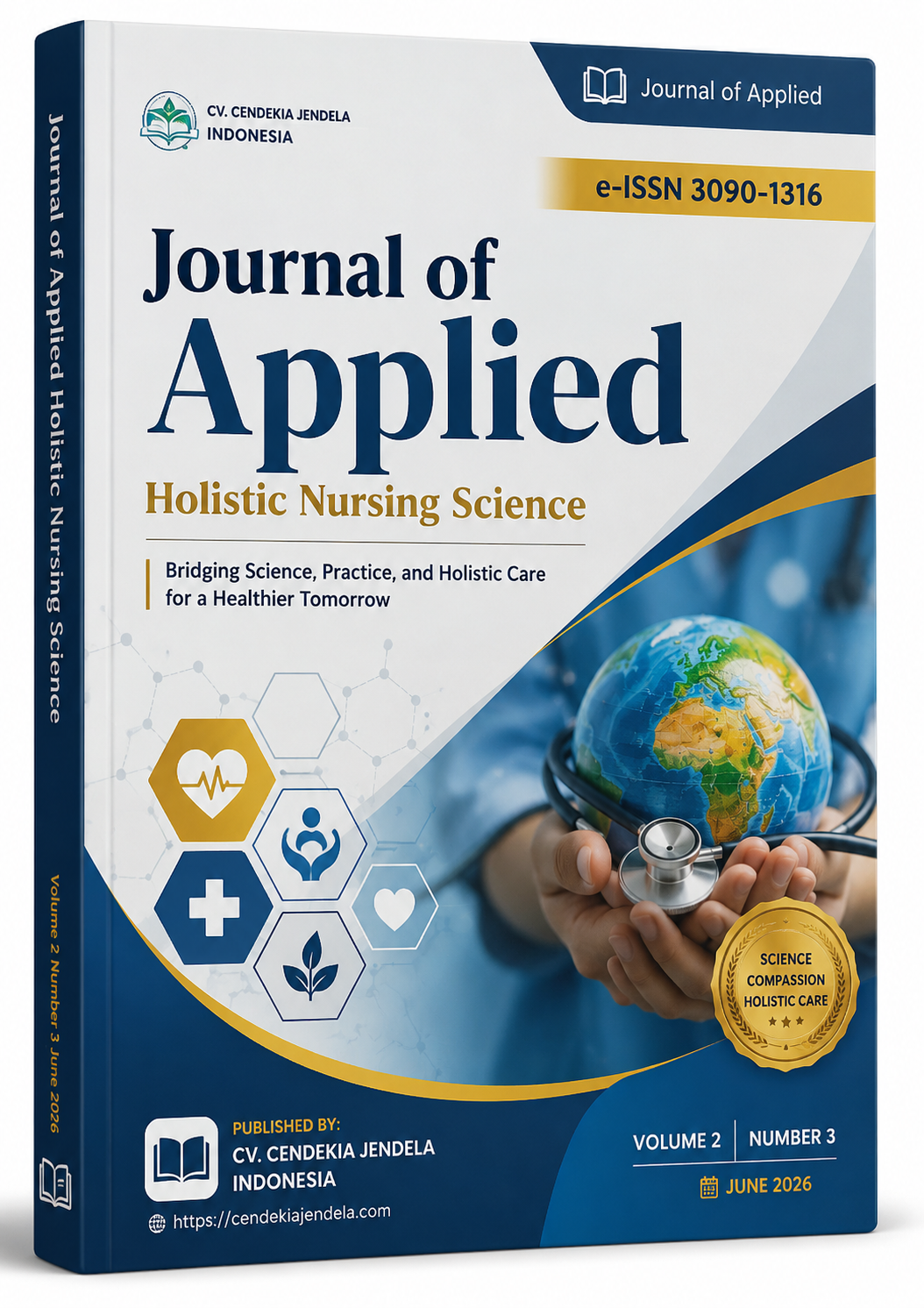
Application of Nursing Care for Pleural Effusion Patients in Pulmonary Ward
Abstract
Background: Pleural effusion is a respiratory disorder characterized by abnormal fluid accumulation in the pleural cavity that may impair pulmonary expansion and gas exchange. Patients with pleural effusion commonly experience dyspnea, productive cough, decreased oxygenation, fatigue, and impaired activity tolerance. Appropriate nursing care is essential to improve respiratory function, maintain airway patency, and enhance patient comfort during hospitalization.
Objective: This study aimed to describe the application of nursing care for pleural effusion patients in a pulmonary ward.
Methods: This study used a descriptive case study design involving one patient diagnosed with pleural effusion in the Pulmonary Ward of Mohammad Natsir Regional Hospital, Solok City. Data were collected through interviews, observation, physical examination, and documentation review from April 2 to April 5, 2025. Data analysis was performed by comparing clinical findings with nursing theories, Indonesian nursing standards, and recent evidence-based literature.
Results: The patient experienced shortness of breath, productive cough, weakness, and limited physical activity. Nursing assessment identified three primary nursing diagnoses, namely ineffective airway clearance, ineffective breathing pattern, and activity intolerance. Nursing interventions included airway management, oxygen therapy, effective coughing exercises, breathing pattern management, positioning, and energy conservation techniques. Evaluation results demonstrated improvement in respiratory status, reduction of dyspnea, decreased sputum accumulation, and better activity tolerance after the interventions were implemented.
Conclusion: The application of comprehensive nursing care contributed positively to respiratory improvement and patient comfort in pleural effusion management. Early assessment, evidence-based respiratory interventions, and continuous nursing monitoring are important to optimize patient outcomes and prevent complications.
Downloads
References
Alligood, M. R. (2022). Nursing theorists and their work (10th ed.). Elsevier.
Bintcliffe, O., Hooper, C., Maskell, N., & Rahman, N. M. (2022). Management of pleural effusion in clinical practice. BMJ, 377, e067784. https://doi.org/10.1136/bmj-2021-067784
Hinkle, J. L., & Cheever, K. H. (2022). Brunner & Suddarth’s textbook of medical-surgical nursing (15th ed.). Wolters Kluwer.
Light, R. W. (2022). Pleural diseases (7th ed.). Lippincott Williams & Wilkins.
Porcel, J. M., & Light, R. W. (2023). Diagnostic approach to pleural effusion in adults. American Family Physician, 107(4), 356–364.
Potter, P. A., Perry, A. G., Stockert, P., & Hall, A. (2023). Fundamentals of nursing (11th ed.). Elsevier.
Rahman, N. M., Ali, N. J., Brown, G., Chapman, S. J., Davies, R. J. O., Downer, N. J., & Hedley, E. L. (2022). British Thoracic Society pleural disease guideline. Thorax, 77(3), 225–240. https://doi.org/10.1136/thoraxjnl-2021-217375
Smeltzer, S. C., Bare, B., Hinkle, J., & Cheever, K. (2022). Textbook of medical surgical nursing. Wolters Kluwer.
World Health Organization. (2023). Global tuberculosis report 2023. https://www.who.int/publications/i/item/9789240083851
Yusra, A., & Deswita, D. (2024). Nursing intervention in respiratory disorders: Clinical perspectives in pulmonary care. Indonesian Journal of Nursing Practice, 8(2), 115–123.
Copyright and License Statement
By submitting a manuscript to the Journal of Applied Holistic Nursing Science, the author agrees to this policy. No specific document approval is required.
Copyright:

Lisensi Creative Commons Atribusi-NonKomersial-BerbagiSerupa 4.0 Internasional
The copyright for any article in the Journal of Applied Holistic Nursing Science is fully held by the author under the Creative Commons CC BY-NC-SA 4.0 license.
1. The copyright of each article belongs to the author.
2. Authors retain all rights to their published work, including but not limited to the rights outlined on this page.
3. The author acknowledges that Journal of Applied Holistic Nursing Science is the first publisher under the Creative Commons Attribution 4.0 International License (CC BY-NC-SA-4.0).
4. Authors may separately submit their work, arrange for non-exclusive distribution of the manuscript previously published in this journal into other versions (e.g., submission to the author's institutional repository, publication in books, etc.), with acknowledgment that the manuscript was first published in Journal of Applied Holistic Nursing Science
5. The author guarantees that the original article, written by the authors named, has not been previously published, does not contain statements that are illegal, does not infringe upon the rights of others, and is subject to copyright exclusively held by the authors.
6. If the article is co-authored by more than one author, each submitting author guarantees that they have been authorized by all co-authors to agree to the copyright and licensing notice (agreement) on their behalf and agrees to inform co-authors of the terms of this policy.Journal of Applied Holistic Nursing Science will not be held liable for any issues arising from internal disputes between authors.
License:
Journal of Applied Holistic Nursing Science is published under the terms of the Creative Commons Attribution-NonCommercial-ShareAlike 4.0 International License (CC BY-NC-SA 4.0). This license allows anyone to:
Copy and redistribute the material in any medium or format, and remix, transform, and build upon the material, even for commercial purposes, as long as they credit the author for the original creation.